
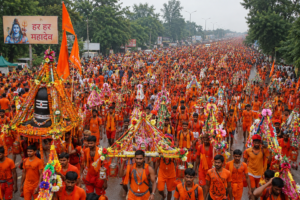
The month of Sawan (Shravan) holds a special place in the spiritual and cultural life of India. It is traditionally associated with Lord Shiva, and devotees across the country observe the month through prayers, fasting, temple visits and other forms of devotion. One of the most prominent expressions of this devotion is the Kanwar yatra, undertaken by Shiva devotees, commonly known as Kanwariyas.
During the Kanwar yatra, devotees travel long distances, often on foot, to collect sacred water from holy rivers and offer it to Lord Shiva at temples, particularly during the auspicious period of Sawan. The journey represents faith, devotion, discipline, perseverance and a deep sense of spiritual commitment. For many devotees, the pilgrimage is not simply a physical journey but an expression of Shraddha (faith), Sankalp (resolve), Seva (service) and Samarpan (dedication).
Viewed through the lens of management, the Kanwar yatra provides an opportunity to understand how communities can organise themselves around a common purpose. It demonstrates several principles that are increasingly relevant to contemporary management: leadership, teamwork, coordination, social responsibility, resource management, resilience, discipline, and collective decision-making.
This makes the Kanwar yatra particularly relevant to the Indian Knowledge Systems (IKS) framework, which recognises the value of indigenous knowledge, practices, values, and community-based systems.
Understanding the Kanwar Yatra as a Collective Management System
Management is often associated with formal organisations, corporations, managers, strategies, and business processes. However, management also exists in communities and social institutions where people voluntarily coordinate their actions to achieve a shared objective. The Kanwar yatra provides an interesting example of such voluntary coordination. Participants follow common practices and routines while navigating large crowds, long distances, changing environmental conditions, and logistical challenges.
The scale of the pilgrimage requires coordination among multiple stakeholders, including pilgrims, volunteers, local communities, government agencies, healthcare workers, law-enforcement personnel, transport providers, and charitable organisations. This creates a temporary but highly complex ecosystem where planning, organising, coordination, leadership, communication and control become essential.
The most interesting aspect is that much of this collective behaviour is not necessarily driven by conventional organisational hierarchies. Instead, it is supported by shared values, social norms, community participation, faith, mutual trust and a sense of seva.
Kanwar Yatra and the Wisdom of Collective Management
The Kanwar yatra can be viewed as a repository of indigenous wisdom that demonstrates how collective action can emerge from shared values and social responsibility.
One important lesson is the principle of seva, or selfless service. Along the pilgrimage routes, communities and volunteers often participate in providing food, water, resting facilities and other forms of assistance. From a management perspective, seva represents a form of value-driven leadership, where motivation is not limited to financial rewards or formal recognition.
Another important lesson is collective responsibility. When large numbers of people participate in a common activity, individual behaviour can influence the experience and safety of the entire community. Cooperation, discipline and consideration for others therefore become essential.
The Kanwar yatra also illustrates the importance of social capital. Social capital refers broadly to the networks, relationships, trust and shared norms that enable people to cooperate. Communities participating in or supporting the pilgrimage create networks of assistance that facilitate collective action.
There is also an important lesson in resilience. Pilgrims may encounter physical challenges, weather conditions, crowded environments and long journeys. The ability to remain committed to a shared objective demonstrates how purpose and collective identity can strengthen individual resilience.
For management education, these practices provide an opportunity to move beyond Western management theories and explore Indian approaches to leadership, motivation, ethics, community and collective responsibility.
From this perspective, the Kanwar yatra can be examined as a living repository of collective wisdom.
Its management lessons can be explored through several dimensions:
- Seva: Service as a source of motivation and social responsibility.
- Leadership: Leadership emerging through participation, responsibility and example.
- Teamwork: Individuals cooperating to achieve a shared purpose.
- Discipline: Adherence to common norms in a complex social environment.
- Resilience: Maintaining commitment despite physical and environmental challenges.
- Social capital: Building trust and networks through community participation.
- Resource sharing: Mobilising community resources for collective benefit.
- Collective identity: Creating a strong sense of belonging around a shared purpose.
These dimensions provide an interesting alternative to purely organisation-centric approaches to management. They encourage researchers and educators to ask an important question: Can management wisdom also be discovered in India’s traditional community practices?
The answer can potentially open new avenues for research in indigenous management, Indian leadership thought and experiential learning.
Kanwar Yatra and Education: From Cultural Practice to Management Classroom
The Kanwar yatra can also become a valuable case study for management education. Business schools increasingly emphasise experiential learning, case-based learning and real-world problem-solving. A large-scale social phenomenon such as the Kanwar yatra can provide students with an opportunity to examine management concepts in a context that is culturally rooted in India.
For example, an MBA classroom could use the Kanwar yatra to examine:
- Organisational Behaviour: How do individuals behave within large groups? What motivates people to cooperate?
- Leadership: How does leadership emerge in decentralised community settings?
- Operations Management: How can large-scale movement, accommodation, food, sanitation and healthcare be coordinated?
- Human Resource Management: How can volunteers be motivated, coordinated and engaged without conventional financial incentives?
- Marketing and Communication: How do information networks and digital platforms influence communication among participants?
- Strategic Management: How can different stakeholders coordinate their resources toward a common objective?
- Business Ethics and CSR: How can the principles of service, responsibility and community welfare inform responsible management?
- Sustainability: How can large-scale pilgrimages address waste management, environmental protection and responsible resource utilisation?
Technology Meets Tradition
Another interesting dimension is the growing role of technology in managing large-scale pilgrimages. Digital communication, mobile applications, online information systems, GPS-based navigation, social media, emergency communication and data-driven planning can complement traditional community-based systems.This creates an interesting intersection between traditional wisdom and modern technology.
The Kanwar yatra therefore provides a potential research setting for examining how indigenous practices can coexist with contemporary management systems. Rather than viewing tradition and technology as opposites, researchers can explore how both can work together to improve coordination, safety, accessibility and sustainability.
The Kanwar yatra can be understood not only as a sacred journey but also as a significant social phenomenon that offers opportunities for studying collective management through an Indian lens.
Studying the Kanwar yatra from a management perspective does not seek to reduce a cultural or spiritual practice to a business process. Instead, it invites us to recognise that management knowledge can emerge from lived experiences, communities and indigenous traditions as well as from formal organisational theories.