
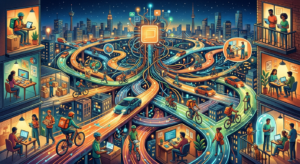
Introduction: In Gig Economy The Workplace Has No Fixed Address Anymore
For generations, employment followed a familiar pattern. A person completed education, joined an organisation, worked from a designated workplace, received a regular salary and gradually progressed through a structured career path. Employment was closely associated with stability, organisational identity and long-term relationships between employers and employees.
That model is changing.
Today, a person can work from a bedroom in Delhi for a company based in London, design a logo for a client in Singapore in the afternoon, teach an online course to students in the United States in the evening and complete a local delivery assignment at night. The boundaries between employee, freelancer, entrepreneur and independent contractor are becoming increasingly fluid.
At the centre of this transformation is the gig economy.
The gig economy refers broadly to a labour market in which individuals undertake short-term, temporary, project-based or task-based assignments rather than relying exclusively on conventional permanent employment. Digital platforms have accelerated this transformation by connecting workers with customers and organisations across geographical boundaries.
The International Labour Organization (ILO) describes digital labour platforms as an important transformation in the organisation of work, creating new opportunities while also generating concerns around working conditions, social protection and worker rights. (International Labour Organization)
What Is the Gig Economy?
The gig economy is an employment environment in which work is organised around individual assignments, projects, contracts or tasks rather than necessarily around permanent jobs. Gig work can take many forms. A software developer may accept a three-month project. A graphic designer may work for multiple clients simultaneously. A consultant may provide expertise to different companies. A delivery worker may accept assignments through a mobile application. An online tutor may teach students located thousands of kilometres away.
The ILO distinguishes between online web-based platform work, where tasks can be completed remotely, and location-based platform work, where services such as transportation, delivery or home services are performed at a physical location. (International Labour Organization)
This diversity is important because the term “gig worker” does not describe a single type of employee. Gig workers can range from highly skilled professionals to workers performing relatively low-skilled, location-based tasks. The OECD similarly notes that platform work can offer flexibility and lower barriers to entering the labour market, while also raising concerns about income security, social protection, career development and collective bargaining. (OECD) Thus, the gig economy should not be viewed simply as an alternative to traditional employment. It represents a broader restructuring of how labour is organised, purchased and delivered.
From the Office to the Platform: The rise of the gig economy is closely connected with digital transformation. Smartphones, cloud computing, digital payments, artificial intelligence, online marketplaces and collaboration tools have reduced the importance of physical proximity. A business no longer necessarily needs to hire a full-time employee for every function. Instead, it can access specialised talent whenever required.
Similarly, professionals no longer need to depend entirely on a single employer for income. This has created what can be called a platform-mediated labour market. Digital platforms perform several functions simultaneously. They can connect buyers and sellers, match workers with assignments, facilitate payments, collect ratings and reviews, and sometimes use algorithms to allocate work.
The ILO has highlighted algorithmic management as one of the major characteristics of platform work. Ratings, reputational systems and automated allocation can influence a worker’s access to assignments and income. (International Labour Organization) The platform, therefore, is not merely a digital noticeboard. It can become an important part of the employment relationship. This is where the gig economy becomes particularly interesting and complicated.
Why Workers Are Choosing the Gig Economy: One of the strongest attractions of the gig economy is flexibility. Traditional employment often requires workers to follow predetermined schedules, organisational structures and workplace arrangements. Gig work can provide greater control over when, where and how a person works. For students, retirees, parents, professionals and individuals seeking additional income, this flexibility can be valuable. The gig economy can also lower entry barriers. A person may not need to relocate to another city or secure a conventional job to begin earning. Digital platforms can connect workers with customers almost immediately.
The Indian Gig Economy: A New Employment Frontier
The country’s large young workforce, expanding digital infrastructure, widespread smartphone adoption and growing platform businesses have created an environment in which gig work can expand rapidly. According to an ILO report published in 2024, NITI Aayog estimated that India’s gig economy had approximately 7.7 million workers in 2020 and projected the number to reach 23.5 million by 2029-30. (International Labour Organization)
The significance of these numbers extends beyond employment statistics.
For young Indians in particular, the gig economy can provide an alternative pathway between education and conventional employment. Instead of waiting for the “right job”, individuals can build portfolios of projects, clients and skills.
This could gradually shift the traditional concept of a career from “one employer, one designation” to “multiple clients, multiple skills and multiple income streams.”
The Freedom of Flexibility and Its Hidden Cost
The flexibility associated with the gig economy comes with an important qualification: flexibility does not automatically mean security. A worker may have greater control over working hours but less certainty about monthly income. A freelancer may enjoy independence but have no guaranteed project next month. A platform worker may be able to log in whenever desired but may also experience fluctuations in demand. A professional working for several clients may have greater autonomy but must continuously search for new opportunities.
When the Algorithm Becomes the Manager
One of the most significant changes introduced by the gig economy is the emergence of algorithmic management. In a traditional organisation, a manager may assign tasks, evaluate performance, monitor attendance and provide feedback. In a platform economy, some of these functions can be performed by algorithms. A digital system may determine which worker receives an assignment, calculate a price, evaluate customer feedback or influence visibility on a platform.
This can make work highly efficient. Algorithms can match demand and supply at remarkable speed.
However, algorithmic management also creates questions about transparency.
What happens when a worker’s rating suddenly falls?
Why does one worker receive more assignments than another?
What happens when an automated decision is incorrect?
As AI becomes more deeply integrated into recruitment, scheduling, performance management and workforce analytics, these questions will become even more important.
What Employers Gain from the Gig Economy
The transformation is not beneficial only to workers. Businesses can gain considerable advantages from gig and platform-based employment.
First, organisations can access specialised talent without necessarily creating permanent positions. A start-up may hire a freelance designer for branding, a cybersecurity consultant for a specific assignment and a financial expert for a short-term project.
Second, companies can become more responsive to changing demand.
Third, the gig economy can provide access to global talent.
A company based in India can collaborate with a content strategist in Europe, a developer in Southeast Asia and a consultant in North America. This creates a genuinely borderless labour market.
From Employees to Personal Brands
Another major impact of the gig economy is the growing importance of personal branding.
In traditional employment, an individual’s professional identity is often closely associated with an organisation. In gig work, the individual becomes a brand. A freelancer’s portfolio, LinkedIn profile, online reviews, professional network, certifications and previous projects can influence future opportunities.
This means that employability is increasingly becoming continuous rather than periodic. A professional cannot simply acquire a degree and stop learning. Skills must be updated continuously. Workers who continuously upgrade their capabilities are better positioned to benefit from the emerging labour market. The modern career may therefore be less about job security and more about skill security.
The Social Protection Question
Perhaps the most important debate surrounding the gig economy concerns social protection. Traditional employees may receive benefits such as paid leave, retirement contributions, health coverage, insurance or other employment protections, depending on their country and employment arrangement. Gig workers may not receive equivalent protection. This creates a fundamental policy challenge: social protection systems were largely designed around conventional employer-employee relationships, while the gig economy increasingly produces more diverse working arrangements.
This development signals an important shift in thinking.
The future of employment cannot depend entirely on whether someone carries the legal label of “employee” or “independent contractor.”
Instead, policymakers increasingly need to ask:
What rights and protections should every person have because they work?
Will the Gig Economy Replace Traditional Employment?
Probably not.
The more likely future is a hybrid employment ecosystem.
Traditional full-time jobs will continue to exist, particularly in sectors where long-term organisational knowledge, confidentiality, regulation and collaboration are essential.
At the same time, gig work, freelancing, consulting, project-based employment and platform work will continue expanding in areas where flexibility and specialised expertise are valuable.
This means that the future workplace may contain several categories of workers:
- Permanent employees
- Freelancers
- Independent professionals
- Platform workers
- Consultants
- Temporary workers
- Project-based specialists
- AI-assisted workers
The challenge for organisations will be learning how to manage this diverse workforce fairly and effectively.
Building a Better Gig Economy
The solution is not to stop technological progress. Instead, society needs to ensure that technological progress is accompanied by responsible employment practices.
For educational institutions, the message is equally important.
Universities can no longer prepare students only for predefined occupations. They must prepare learners to continuously adapt, collaborate digitally, manage projects and create value in changing environments. The future graduate may not have one job title for an entire career. They may have several.
Conclusion:
The phrase “going to work” once meant travelling to a particular location, reporting to a manager and completing assigned responsibilities. Today, work can happen anywhere.
A laptop can become an office. A smartphone can become a workplace. A digital platform can become a marketplace. An online profile can become a professional identity. That is the deeper significance of the gig economy.
It is not merely creating another category of workers. It is challenging society to reconsider what employment itself means. The future will probably not belong exclusively to permanent employment or gig work. Instead, it will belong to an ecosystem where different forms of work coexist. The central task for governments, businesses, educational institutions and workers is to make that ecosystem inclusive. Because the real measure of the future of work should not be how flexible employment becomes.