
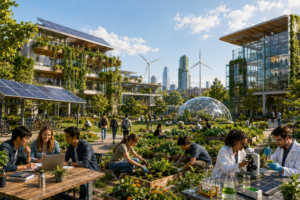
Introduction to Living Laboratories
In today’s rapidly changing world, universities are expected to do more than provide classroom education. They are now becoming active centers of innovation, sustainability, and social transformation. One of the most exciting developments in this direction is the rise of living laboratories in higher education. These innovative learning ecosystems allow students, faculty, researchers, and communities to work together on real-world sustainability challenges directly on campus.
The concept is simple yet powerful. Instead of learning sustainability only through textbooks and lectures, students experience it through practical projects, experiments, and collaborations. Universities transform their campuses into testing grounds where sustainable ideas can be developed, implemented, and evaluated in real time. As climate change, resource depletion, and environmental concerns continue to grow, higher education institutions are increasingly adopting living laboratory models to prepare students for the future. These initiatives encourage experiential learning, innovation, and community engagement while improving campus sustainability practices.
According to the United Nations Sustainable Development Goals, educational institutions play a crucial role in building sustainable societies. Living laboratories directly contribute to this mission by promoting practical learning and sustainable development.
What Are Living Laboratories in Higher Education?
How Living Laboratories Enhance Sustainability Education
Living laboratories are collaborative environments where universities use their campuses as real-life experimental spaces for research, innovation, and sustainability initiatives. These laboratories integrate education, operations, research, and community partnerships into one dynamic system. Unlike traditional laboratories that operate in controlled settings, living laboratories function in actual environments where students and stakeholders interact with real-world systems. This approach makes learning more meaningful and impactful.
Features of Living Laboratories
Some common characteristics of successful living laboratories include:
- Real-world problem-solving
- Collaboration among students, faculty, industry, and communities
- Interdisciplinary learning
- Sustainability-focused innovation
- Continuous experimentation and feedback
- Data-driven decision-making
For example, a university may involve engineering students in designing solar-powered systems for campus buildings while business students analyze cost efficiency and environmental science students evaluate ecological impact. Such collaboration creates holistic learning experiences.
Why Living Laboratories Matter in Modern Universities
The growing importance of sustainability has made living laboratories essential in modern higher education systems. Universities are uniquely positioned to lead sustainability transitions because they combine education, research, infrastructure, and community influence.
Bridging Theory and Practice
One major strength is their ability to bridge the gap between theoretical knowledge and practical application. Students often struggle to connect classroom concepts with real-life situations. Living laboratories solve this problem by immersing students in practical projects.
For instance, students studying renewable energy can directly monitor campus solar panels, analyze energy consumption patterns, and propose improvements. This hands-on approach improves understanding and retention. Moreover, employers increasingly seek graduates with practical experience, problem-solving abilities, and teamwork skills. Living laboratories help students develop these competencies naturally.
Enhancing Student Engagement
Traditional lectures can sometimes feel disconnected from reality. However, living laboratories make learning interactive and engaging. Students become active participants rather than passive learners. When students work on actual campus sustainability issues, they feel a sense of ownership and responsibility. This emotional connection often increases motivation and innovation. Additionally, it encourage creativity because students are challenged to think critically and design practical solutions for complex problems.
Historical Development of Living Laboratories
This concept is originated in Europe during the early 2000s as part of open innovation and user-centered research approaches. Over time, universities adapted this idea to sustainability and campus management.
Initially, it focused mainly on technology testing. However, they gradually expanded into broader sustainability themes such as:
- Energy conservation
- Waste reduction
- Sustainable transportation
- Water management
- Green building design
- Biodiversity conservation
Today, many leading universities across the world have adopted living laboratory models as part of their sustainability strategies.
Key Components of Successful Living Laboratories
Its success depend on several interconnected components that support collaboration, experimentation, and innovation.
Collaboration Between Stakeholders
Living laboratories thrive on partnerships. Students, faculty members, administrators, local governments, industries, and communities must work together to achieve sustainability goals.
Real-Time Problem Solving
It addresses actual campus challenges rather than hypothetical situations. This practical focus improves learning quality and research relevance.
Examples include:
- Reducing electricity consumption in hostels
- Improving waste segregation systems
- Monitoring water leakage
- Designing eco-friendly transportation systems
Because these problems affect the campus community directly, solutions can be tested and improved continuously.
Living Laboratories and Campus Sustainability
One of the biggest advantage is their contribution to campus sustainability. Universities can significantly reduce their environmental impact while creating educational opportunities.
Energy Management Projects
Energy conservation is a common focus area where students and researchers often collaborate on projects involving:
- Solar energy systems
- Smart lighting
- Energy-efficient buildings
- Renewable energy monitoring
These projects help campuses lower operational costs and carbon emissions.
For example, installing motion-sensor lighting in classrooms can reduce unnecessary electricity usage while providing students with valuable technical experience.
Waste Management Initiatives
Waste management projects are another important component. Universities generate large amounts of waste daily, making campuses ideal testing grounds for sustainable waste solutions.
Common initiatives include:
- Recycling programs
- Composting systems
- Plastic-free campus campaigns
- Waste segregation awareness
Students actively participate in designing and evaluating these systems, which enhances environmental awareness.
Water Conservation Programs
Water scarcity has become a major global issue. We address this challenge through innovative water conservation projects such as:
- Rainwater harvesting
- Greywater recycling
- Smart irrigation systems
- Leak detection technologies
These initiatives not only conserve resources but also teach students about sustainable resource management.
Role of Technology in Living Laboratories
Technology plays a central role in the success of modern living. Universities increasingly rely on digital tools to monitor, analyze, and improve sustainability initiatives.
Smart Campuses and IoT
The Internet of Things (IoT) enables campuses to collect real-time data from various systems such as energy meters, water pipelines, and waste bins. Smart campuses use sensors and connected devices to improve operational efficiency. Students can analyze this data to identify sustainability challenges and recommend solutions.
Examples include:
- Smart temperature control systems
- Automated irrigation systems
- Digital waste monitoring
- Smart parking management
These technologies make living laboratories more efficient and data-driven.
Data Analytics for Sustainability
Data analytics helps universities measure the effectiveness of sustainability initiatives. Students can use analytical tools to evaluate trends, predict outcomes, and optimize resource use. For example, analyzing electricity consumption data may reveal patterns that help reduce peak energy demand. The integration of artificial intelligence and machine learning is also expanding the capabilities of living laboratories.
Benefits of Living Laboratories for Students
It provide numerous educational and professional benefits for students.
Skill Development
Students develop valuable skills including:
- Critical thinking
- Leadership
- Communication
- Project management
- Research abilities
- Team collaboration
These competencies are highly valued in today’s job market. It improves employability because students learn how to apply theoretical concepts in real situations.
Research and Innovation Opportunities
It create excellent opportunities for research and innovation. Students can conduct experiments, collect data, and develop solutions for sustainability challenges. Many universities encourage interdisciplinary research projects where students from different departments collaborate on shared sustainability goals. This approach promotes creativity and innovation while strengthening academic research.
Benefits for Universities and Communities
The impact of living laboratories extends beyond students. Universities and surrounding communities also benefit significantly.
Some major institutional benefits include:
- Improved campus sustainability
- Reduced operational costs
- Enhanced institutional reputation
- Increased research funding opportunities
- Stronger industry partnerships
Communities benefit because universities often share successful sustainability practices with local organizations and governments.
As a result, living laboratories contribute to broader social and environmental development.
Living Laboratories in Indian Higher Education
Indian universities are also embracing the concept of living laboratories. As sustainability becomes a national priority, many institutions are introducing campus-based innovation projects.
Areas of focus include:
- Solar energy adoption
- Waste management systems
- Water conservation
- Green campus initiatives
- Sustainable transportation
The implementation of the National Education Policy (NEP) 2020 has further encouraged experiential and multidisciplinary learning, creating favorable conditions for living laboratories in India. Institutions across Delhi-NCR, Uttar Pradesh, and other regions are increasingly integrating sustainability projects into academic programs.
Strategies to Strengthen Living Laboratories
To maximize the impact of living laboratories, universities should adopt strategic approaches.
Key Recommendations
- Develop clear sustainability policies
- Encourage interdisciplinary collaboration
- Increase industry partnerships
- Provide funding for innovation projects
- Integrate sustainability into curriculum
- Use technology for monitoring and evaluation
- Promote community engagement
Universities should also recognize student contributions and create platforms for sharing innovative ideas.
Future of Living Laboratories in Higher Education
The future of living laboratories looks extremely promising. As sustainability challenges continue to grow, universities will play an increasingly important role in developing practical solutions. Emerging technologies such as artificial intelligence, smart infrastructure, and digital twins are expected to enhance the effectiveness of living laboratories. In the coming years, universities may evolve into fully integrated smart ecosystems where education, research, and sustainability operate together seamlessly. Living laboratories will likely become essential components of higher education institutions worldwide.
FAQs
- What are living laboratories in higher education?
Living laboratories are real-world learning environments where universities use their campuses to test and implement sustainability solutions through collaboration among students, faculty, and communities.
- Why are living laboratories important?
They bridge the gap between theory and practice, improve student engagement, support sustainability goals, and promote innovation.
- How do students benefit from living laboratories?
Students gain practical experience, research opportunities, leadership skills, and problem-solving abilities that improve employability.
- What sustainability areas are commonly addressed in living laboratories?
Common focus areas include energy conservation, waste management, water conservation, smart technologies, and sustainable transportation.
- Are living laboratories only related to environmental sustainability?
No. While environmental sustainability is a major focus, living laboratories also address social innovation, urban development, public health, and community engagement.
Pingback: Pedal Today, Serve the Nation: Saving Fuel for a Stronger India - brightsidechronicle.fun