
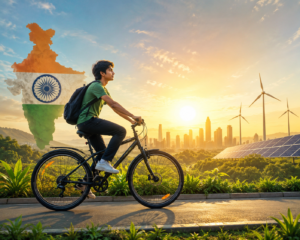
India’s future will not only be shaped by technological advancement and economic growth but also by the everyday choices of its citizens. In recent years, the world has witnessed increasing global conflicts and economic instability. Every international crisis directly impacts the common citizen through increased transportation costs, inflation, and pressure on national resources. At such a crucial time, our Hon’ble Prime Minister Shri Narendra Modiji has encouraged citizens to save petrol and diesel, avoid unnecessary travel, and adopt responsible lifestyles for the betterment of the nation.
As responsible citizens and educators, it is time for us to rethink one simple yet powerful habit that can transform both our lives and our country – “cycling”.
Cycling is a symbol of discipline, sustainability, self-reliance, patriotism, and healthy living. In today’s fast-moving world, where convenience often dominates responsibility, choosing a bicycle over a fuel-powered vehicle for short distances can become a meaningful contribution towards nation-building.
A Small Step by Every Citizen Can Create a Big National Impact
India is one of the fastest-growing economies in the world. With growth comes increased energy consumption. A significant portion of our fuel requirement is imported from other countries, which means every litre of petrol or diesel we save strengthens our economy and reduces dependence on foreign resources.
Imagine if people started using bicycles for nearby travel going to markets, schools, parks, coaching centers, or workplaces within short distances. The cumulative impact would be extraordinary:
- Reduction in fuel consumption
- Less traffic congestion
- Cleaner air and reduced pollution
- Better public health
- Lower transportation expenses
- Stronger environmental consciousness among youth
Most importantly, it would reflect a spirit of collective patriotism where citizens actively participate in strengthening the nation through daily habits.
Why Students Must Lead This Movement
The youth of India have always been the driving force behind social change. Today’s students are tomorrow’s policymakers, entrepreneurs, educators, scientists, and leaders. If students adopt sustainable transportation habits today, they will naturally build a more responsible society tomorrow.
Educational institutions can play a transformative role in this mission. Schools, colleges, and universities should encourage “Cycle-to-Campus” initiatives, organize awareness drives, and create cycling-friendly environments. Even dedicating one day a week as a “No Fuel Day” on campuses can inspire thousands of young minds.
Cycling and Health: A Powerful Combination
Also, in an age where excessive screen time and sedentary lifestyles are affecting the physical and mental health of students, cycling can become a simple solution with lifelong benefits. Cycling offers a natural and enjoyable form of exercise that improves both physical and mental well-being.
Reconnecting with Simplicity and Indian Values
There was a time when bicycles were an integral part of Indian life. Students rode to schools, workers travelled to offices, and families used bicycles for daily errands. Life was simpler, healthier, and less dependent on fuel. Today, despite technological advancement, people often use vehicles even for extremely short distances. Convenience has increased, but physical activity has reduced. Along with that, pollution and fuel dependency have also grown.
Perhaps it is time to reconnect with the wisdom of simplicity.
Cycling reminds us that progress does not always mean excess consumption. Sometimes, true progress lies in balancing development with responsibility. India has always believed in the philosophy of “simple living and high thinking.” Choosing a bicycle for nearby travel beautifully reflects this philosophy.
Imagine the impact if:
- Students cycle to colleges once or twice a week
- Residential societies promote cycling culture
- Universities organize cycling marathons
- Parents encourage children to use bicycles
- Offices create cycle parking facilities
- Communities celebrate “Cycle Sundays”
Such initiatives can gradually transform public behavior and inspire future generations. The objective is not to completely stop using vehicles. Rather, the aim is to avoid unnecessary fuel consumption wherever possible.
The Emotional Connection: Cycling as an Act of Patriotism
When we save fuel, we support the economy.
When we reduce pollution, we protect India’s future generations.
When we stay healthy, we strengthen the nation’s productivity.
When we inspire others, we create social change.
Let us inspire students, families, institutions, and communities to rediscover the power of cycling.
This is patriotism in action.