
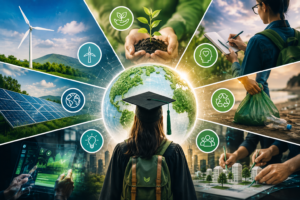
The twenty-first century has brought unprecedented opportunities as well as complex global challenges. Climate change, environmental degradation, resource depletion, social inequality, rapid technological advancement, and economic uncertainty are reshaping the way societies function. As these challenges become increasingly interconnected, educational institutions are expected to prepare students not only for employment but also for responsible participation in creating a sustainable future.
In this evolving landscape, sustainability has emerged as a critical area of knowledge and practice. It is no longer limited to environmental conservation or ecological studies. Instead, sustainability encompasses environmental stewardship, social responsibility, and economic resilience. Organizations across industries are actively seeking professionals who understand these principles and can integrate them into decision-making processes.
Higher education institutions have a significant role to play in developing sustainability competencies among students. Universities are expected to produce graduates who can think critically, solve complex problems, collaborate across disciplines, and lead transformative change. Consequently, sustainability skills have become essential attributes for future-ready graduates.
Students who acquire sustainability competencies before graduation are better positioned to address global challenges, contribute to organizational success, and become responsible global citizens. The following seven sustainability skills are particularly important for every student aspiring to succeed in both professional and personal life.
Why Sustainability Skills Are Essential in Higher Education
The purpose of higher education has evolved significantly over the past few decades. Universities are no longer solely responsible for transmitting knowledge; they are also expected to prepare students to address real-world challenges.
Sustainability education equips students with the ability to understand the interconnected nature of global issues. It encourages them to consider the environmental, social, and economic consequences of their decisions. More importantly, it develops a mindset focused on long-term thinking rather than short-term gains. Employers today increasingly prioritize candidates who demonstrate sustainability awareness. Businesses are adopting Environmental, Social, and Governance (ESG) practices, governments are implementing sustainability policies, and international organizations are promoting sustainable development goals. As a result, graduates with sustainability skills enjoy a competitive advantage in the job market.
Furthermore, sustainability education helps students become active contributors to society. They learn how their actions affect communities, ecosystems, and future generations. This awareness fosters a sense of responsibility and encourages ethical behavior in both personal and professional contexts.
Sustainability Skill 1: Systems Thinking
Understanding the Bigger Picture
One of the most fundamental sustainability skills is systems thinking. This skill enables students to understand how different systems interact and influence one another. Modern challenges rarely exist in isolation. Climate change affects agriculture, public health, water resources, economic productivity, and social stability. Similarly, technological innovation influences employment patterns, education systems, and environmental outcomes.
Systems thinking encourages students to examine relationships rather than isolated events. Instead of focusing solely on individual problems, they learn to identify root causes and understand broader implications.
For example, consider plastic pollution. A systems thinker would not simply focus on waste disposal. They would analyze production methods, consumer behavior, recycling infrastructure, government regulations, corporate responsibility, and environmental impacts.
Students who develop systems thinking become more effective problem-solvers because they can:
- Recognize patterns and connections
- Understand cause-and-effect relationships
- Anticipate unintended consequences
- Design comprehensive solutions
- Evaluate long-term impacts
In professional settings, systems thinking enables graduates to make informed decisions that balance economic, social, and environmental considerations.
Sustainability Skill 2: Environmental Literacy
Developing Awareness of Environmental Challenges
Environmental literacy is the foundation upon which sustainability knowledge is built. It refers to an individual’s understanding of environmental systems and the challenges facing the planet. Students must develop a clear understanding of issues such as climate change, biodiversity loss, pollution, resource scarcity, renewable energy, and sustainable consumption.
Environmental literacy goes beyond awareness. It involves the ability to analyze environmental information, evaluate evidence, and make informed decisions. Students must understand not only what environmental problems exist but also why they occur and how they can be addressed. For instance, understanding climate change requires knowledge of greenhouse gas emissions, energy consumption patterns, industrial activities, and policy interventions.
Environmental literacy empowers students to:
- Adopt sustainable lifestyles
- Make environmentally responsible choices
- Support conservation initiatives
- Participate in sustainability discussions
- Advocate for environmental protection
Universities can enhance environmental literacy through sustainability-focused courses, green campus initiatives, field visits, research projects, and awareness campaigns.
As environmental concerns continue to shape global policy and business practices, environmental literacy will remain a highly valuable competency for graduates across all disciplines.
Sustainability Skill 3: Critical and Ethical Decision-Making
Making Responsible Choices in Complex Situations
The ability to make ethical and evidence-based decisions is central to sustainability. Students often encounter situations where competing interests must be balanced.
For example, should a company prioritize profit maximization if it results in environmental damage? How should governments balance economic development with conservation efforts? What responsibilities do organizations have toward future generations?
Critical thinking enables students to evaluate information objectively, question assumptions, and assess alternative perspectives. Ethical decision-making ensures that choices align with principles of fairness, accountability, and social responsibility. Sustainability requires individuals to consider multiple stakeholders, including employees, communities, customers, investors, and the environment. Therefore, ethical reasoning becomes essential.
Students who develop this skill are better equipped to:
- Analyze complex problems
- Evaluate risks and benefits
- Consider long-term consequences
- Resolve ethical dilemmas
- Make transparent and responsible decisions
Organizations increasingly value professionals who demonstrate integrity and ethical judgment, making this sustainability competency particularly relevant in today’s workplace.
Sustainability Skill 4: Sustainable Innovation and Creativity
Creating Solutions for a Better Future
Innovation has always been a driver of human progress. However, sustainability demands a new form of innovation one that generates positive environmental, social, and economic outcomes simultaneously.
Sustainable innovation focuses on solving challenges while minimizing negative impacts. It encourages students to think creatively about how resources can be used more efficiently and how systems can be redesigned for greater sustainability.
Examples of sustainable innovation include:
- Renewable energy technologies
- Electric vehicles
- Green building designs
- Circular economy business models
- Sustainable agriculture techniques
- Water conservation technologies
Students who cultivate creativity and innovation become capable of identifying opportunities where others see obstacles. They learn to challenge conventional thinking and develop practical solutions for emerging challenges.
Educational institutions can nurture innovation through entrepreneurship programs, design thinking workshops, innovation labs, and interdisciplinary projects. In an increasingly competitive global economy, organizations seek individuals who can combine creativity with sustainability principles to drive meaningful change.
Sustainability Skill 5: Collaboration and Stakeholder Engagement
Working Together to Solve Global Challenges
No single organization, government, or individual can solve sustainability challenges alone. Success requires collaboration among diverse stakeholders. Effective collaboration involves communication, teamwork, empathy, negotiation, and cultural understanding. Students must learn how to work with people from different backgrounds, disciplines, and perspectives.
Sustainability projects often involve multiple stakeholders with varying priorities. For example, developing a renewable energy project may require cooperation among government agencies, private companies, local communities, environmental organizations, and academic institutions.
Students who develop collaboration skills can:
- Build productive relationships
- Facilitate dialogue among stakeholders
- Resolve conflicts effectively
- Foster mutual understanding
- Achieve collective goals
Stakeholder engagement is equally important. It involves identifying affected groups, understanding their concerns, and incorporating their perspectives into decision-making processes.
These abilities are highly valued by employers because modern workplaces increasingly rely on teamwork and cross-functional collaboration.
Sustainability Skill 6: Data Literacy and Analytical Thinking
Using Data to Drive Sustainable Decisions
The digital age has transformed the way organizations operate. Sustainability initiatives increasingly rely on data to measure performance, monitor progress, and identify opportunities for improvement. Data literacy refers to the ability to collect, interpret, analyze, and communicate information effectively.
Students with strong analytical skills can evaluate sustainability indicators such as:
- Carbon emissions
- Energy consumption
- Water usage
- Waste generation
- Social impact metrics
- ESG performance indicators
Data-driven decision-making enables organizations to allocate resources efficiently and track progress toward sustainability goals.
For example, a company seeking to reduce energy consumption must first analyze energy usage patterns before implementing improvement strategies.
Students who master data literacy can:
- Interpret complex information
- Identify meaningful trends
- Support evidence-based decisions
- Communicate findings clearly
- Evaluate sustainability performance
As businesses continue to embrace digital transformation, data literacy has become an indispensable sustainability skill.
Sustainability Skill 7: Leadership for Sustainable Development
Inspiring Action and Driving Change
Leadership is the skill that connects all other sustainability competencies. Sustainable leaders inspire individuals and organizations to work toward long-term goals that benefit society and the environment.
Unlike traditional leadership models that often focus solely on financial outcomes, sustainability leadership emphasizes shared value creation and long-term impact.
Effective sustainability leaders demonstrate:
- Vision
- Integrity
- Accountability
- Empathy
- Strategic thinking
- Adaptability
- Resilience
These leaders understand that meaningful change requires collaboration, innovation, and persistence. Students can develop leadership skills by participating in student organizations, sustainability initiatives, volunteer activities, community projects, and leadership development programs. Graduates who possess sustainability leadership capabilities are well-positioned to influence organizational strategies, drive innovation, and contribute to positive societal transformation.
Integrating Sustainability Skills into University Education
Universities must actively integrate sustainability into teaching, research, and campus operations. Sustainability should not be confined to a single course or department; it should be embedded throughout the educational experience.
Effective approaches include:
- Interdisciplinary learning opportunities
- Sustainability-focused research projects
- Community engagement initiatives
- Industry partnerships
- Experiential learning programs
- Sustainable campus practices
Such initiatives provide students with practical opportunities to apply sustainability concepts in real-world contexts. By integrating sustainability across disciplines, universities can ensure that graduates are prepared to address complex global challenges regardless of their chosen career path.
Career Advantages of Sustainability Skills
The demand for sustainability professionals continues to grow across industries. Organizations recognize that sustainability contributes to risk management, innovation, reputation enhancement, and long-term profitability.
Students with sustainability competencies can pursue careers in:
- Corporate Sustainability
- ESG Management
- Renewable Energy
- Environmental Consulting
- Sustainable Finance
- Supply Chain Management
- Public Policy
- Education
- Non-Profit Organizations
- Social Entrepreneurship
In addition to creating employment opportunities, sustainability skills enhance career resilience by enabling graduates to adapt to changing market conditions. These competencies are increasingly viewed as essential future skills rather than specialized expertise.
FAQs
- What are sustainability skills?
Sustainability skills are competencies that help individuals address environmental, social, and economic challenges while promoting long-term development and responsible decision-making.
- Why are sustainability skills important for students?
These skills prepare students for future careers, enhance employability, encourage responsible citizenship, and enable them to contribute effectively to solving global challenges.
- Which sustainability skill is most valuable?
All sustainability skills are interconnected. However, leadership, systems thinking, and critical decision-making are often considered particularly valuable because they influence many other competencies.
- How can students develop sustainability skills?
Students can develop these skills through coursework, internships, research projects, volunteer activities, sustainability clubs, and experiential learning opportunities.
- Do sustainability skills improve career prospects?
Yes. Employers increasingly seek professionals who understand sustainability principles and can contribute to organizational ESG and sustainability goals.