
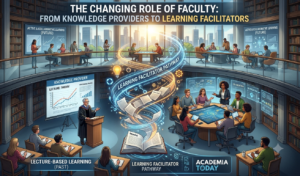
What if the teacher is no longer the smartest person in the classroom?
Twenty years ago, a classroom had a fairly predictable structure.
The teacher had the knowledge.
The textbook had the answers.
Students listened, took notes, studied, and reproduced what they had learned in examinations.
Today, the classroom looks very different.
A student can access a lecture from a global university, read a research paper, watch a tutorial, explore a case study, consult multiple sources, or ask an AI tool to explain a complex concept all within minutes.
So, a question naturally arises:
If information is available everywhere, what should the teacher do?
Perhaps the answer is not to compete with information.
Perhaps the answer is to teach students what to do with information.
And this is where I believe the changing role of faculty becomes particularly important.
- From “I Teach” to “I Help You Learn”
For a long time, teaching was largely understood as knowledge transfer.
The teacher knew. The student learned.
But the modern classroom is increasingly moving toward a different model. The faculty member is becoming a learning facilitator. This does not mean that teachers no longer teach concepts, theories, models, or frameworks. It means that teaching is increasingly about helping students understand:
- Why does this matter?
- How can it be applied?
- What happens when circumstances change?
- What evidence supports this idea?
- What alternative perspectives exist?
Consider a simple example. A teacher can explain employee motivation through theories and models.
Or the teacher can ask:
“You are the HR manager of an organisation where employees are leaving despite competitive salaries. What could be the reason?”
The classroom immediately changes.
Students have to think. They have to analyse. They have to question assumptions. They have to apply theory.
The teacher has moved from being the source of every answer to becoming the designer of meaningful questions. And sometimes, a good question can teach more than a good lecture.
- The Classroom Is No Longer a One-Way Street
Traditional teaching often followed a simple pattern: Teacher → Student
But student-centered learning creates a different dynamic: Teacher ↔ Student
Students discuss. Students question. Students challenge assumptions. Students collaborate. Students research.
And sometimes, students bring knowledge into the classroom that the teacher had not considered. This does not make the teacher less important. It makes the teacher’s role more sophisticated. The classroom therefore becomes more than a place where information is delivered. It becomes a place where ideas are tested.
- When Google Knows the Answer, What Should a Teacher Teach?
This is one of the most interesting questions facing modern education. Students can search definitions. They can find statistics. They can watch tutorials. They can access research papers.
And now, generative AI can provide explanations.
So should teachers compete with technology?
I don’t think that is the right question.
The better question is:
What can teachers help students do with the information they find?
This is where critical thinking in education becomes essential.
Imagine a student asks an AI tool: “What are the major causes of employee turnover?”
The tool provides ten possible reasons.
The teacher can then ask:
- How do you know this information is reliable?
- Would these reasons apply equally to a start-up and a multinational organisation?
Now the learning has moved beyond information and this is where the modern faculty member adds enormous value.
- AI May Change Teaching. It Does Not Eliminate the Need for Teachers.
A student may understand a concept but lack confidence. Another may have excellent academic ability but struggle to communicate. Another may have a creative idea but hesitate to express it.
And sometimes, a student simply needs a teacher to say:
“Try once more. I believe you can do it.”
That human connection matters. Perhaps the future should not be framed as: Teacher vs. AI
but rather: Teacher + AI
- The Lecture Is Not Dead. But It Has Competition.
I don’t believe that lectures need to disappear.
A good lecture can introduce complex concepts, provide structure, explain difficult theories, and connect multiple ideas.
Imagine a 60-minute class on leadership.
Instead of spending the entire hour explaining leadership theories, a faculty member could:
Introduce the concept, Present a leadership dilemma, Ask students to work in groups, Let them defend different decisions, Introduce a real organisational example, End with reflection.
- From Case Studies to Real Problems
Management education provides countless opportunities for experiential learning. Suppose the topic is recruitment. One approach is to explain recruitment sources, selection methods, interviews, and onboarding.
Another approach is to tell students:
“You are the HR team of a growing organisation. You need to recruit 20 employees within 30 days. Your recruitment budget is limited and employee turnover is high. Design your recruitment strategy.”
Now students have a real problem.
They have constraints. They need to make decisions. They have to justify those decisions.
This is where theory becomes meaningful. The classroom becomes a laboratory for learning.
Students can make decisions, make mistakes, rethink them, and learn from the consequences before facing similar challenges in professional life.
- What Happens When Students Start Teaching the Teacher?
One of the most beautiful aspects of student-centered learning is that learning does not always move in one direction.
A student may introduce an unexpected example. Another may challenge an assumption.
Someone may bring professional experience into the classroom. This creates something powerful: reciprocal learning.
The teacher remains an academic expert, but the classroom becomes a space where knowledge can move in multiple directions. I believe some of the most meaningful classroom moments begin with a teacher saying:
“That’s an interesting question. Let’s explore it.”
- The New Faculty Role: Mentor, Not Just Instructor: The faculty role in higher education increasingly extends beyond classroom teaching. Students need guidance in Research, Projects, Career exploration, Internships, Communication, Professional development, Academic challenges, Decision-making. This makes mentoring increasingly important.
- The Teacher’s New Superpower Is Not Knowing Everything
The changing role of faculty is not about replacing teaching with technology. It is about redefining what teaching means.
The teacher remains a source of knowledge but is no longer its only source.
The teacher remains an expert but also becomes a facilitator.
The teacher remains an instructor but increasingly becomes a mentor.
And perhaps most importantly, the teacher creates an environment where students learn to think for themselves. Because in a world where information can be obtained in seconds:
Knowledge is no longer the destination.
The classroom is changing.
The learner is changing.
Technology is changing.
And therefore, the teacher must change too. Because the future of education does not belong simply to those who can deliver knowledge. It belongs to those who can transform knowledge into learning.