
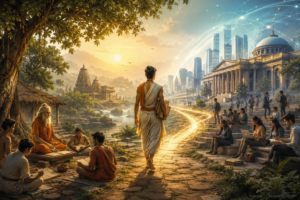
Education has always played a central role in shaping civilizations and guiding societies toward progress. Throughout human history, educational systems have evolved according to cultural values, social structures, and technological advancements. The journey From Gurukul to Global Universities: A Mythological Perspective on Higher Education represents not merely a transition in educational institutions but also a transformation in the philosophy, purpose, and practice of learning.
The ancient Indian educational tradition viewed learning as a sacred pursuit intended to create responsible individuals who could contribute positively to society. Education was not considered a process of obtaining degrees or professional qualifications; rather, it was a path toward acquiring wisdom, self-awareness, discipline, and ethical understanding. In contrast, modern higher education systems operate within a rapidly changing global environment where innovation, technology, research, and employability have become major priorities.
Although the contexts of ancient and modern education appear significantly different, a closer examination reveals remarkable similarities. The values of mentorship, holistic learning, practical knowledge, and social responsibility that were emphasized in traditional Gurukuls continue to influence contemporary educational systems. The transformation from ancient educational practices to globally connected universities demonstrates the enduring relevance of mythological and philosophical ideas in shaping higher education.
Gurukul System: The Ancient Foundation of Higher Education
The Gurukul system represented one of the earliest and most comprehensive forms of organized education in ancient India. The word “Gurukul” combines two Sanskrit terms: “Guru,” meaning teacher, and “Kula,” meaning family or home. In this educational model, students lived in close association with their Guru and learned within a natural environment where education became an integral part of daily life.
Unlike modern classroom systems that separate academic learning from personal development, Gurukul education adopted a holistic approach. Students received instruction not only in academic subjects but also in ethics, philosophy, spirituality, arts, governance, astronomy, medicine, and practical life skills. The educational process aimed at creating balanced individuals capable of intellectual and moral leadership.
The relationship between the Guru and disciple was considered sacred. Teachers did not simply transfer information; they acted as mentors, guides, and role models who shaped the character and personality of students. Learning occurred through observation, participation, dialogue, and practical experience rather than through memorization alone.
The Gurukul environment promoted simplicity and discipline. Students performed daily activities independently, which helped cultivate qualities such as responsibility, patience, self-control, and humility. Education was viewed as a lifelong process that prepared individuals to fulfill their duties toward society and humanity. The ancient Gurukul system thus established educational principles that continue to inspire modern approaches to teaching and learning.
Mythological Perspectives on Higher Education in Ancient India
Indian mythology provides extensive insights into educational values and practices. Ancient epics such as the Mahabharata and Ramayana portray education as a transformative journey that shaped both personal and social identities. The educational experiences of mythological figures reveal the significance of dedication, discipline, and moral conduct in the learning process. These stories continue to serve as important examples for understanding educational philosophy.
The story of Lord Krishna studying under Sage Sandipani demonstrates the principle that education requires humility and discipline regardless of social or personal status. Despite being considered divine, Krishna followed the same educational rules and responsibilities as every other student. This narrative highlights the idea that knowledge can only be acquired through sincerity and effort.
Similarly, the training of the Pandavas and Kauravas under Dronacharya illustrates the importance of mentorship and specialized education. Dronacharya recognized the unique abilities of his students and developed their talents accordingly. This approach resembles modern concepts of personalized learning, where educational strategies are designed according to individual strengths and capabilities.
The story of Eklavya remains one of the most thought-provoking examples within educational discourse. Although Eklavya was denied formal admission into Dronacharya’s Gurukul, his determination and self-learning enabled him to master archery independently. This narrative raises important questions concerning accessibility, equality, and educational opportunities.
In the present educational environment, Eklavya’s experience reflects the increasing role of online learning platforms and open educational resources that enable students to access knowledge beyond institutional boundaries.
Ancient Universities and the Expansion of Knowledge Systems
As societies evolved, educational systems gradually expanded beyond Gurukuls into larger institutional structures. Ancient India witnessed the emergence of universities that attracted scholars and students from different parts of the world.
Institutions such as Takshashila and Nalanda became internationally recognized centers of higher learning. These universities represented some of the earliest examples of organized academic systems and significantly contributed to intellectual development.
The educational environment within these universities was highly diverse and interdisciplinary. Students studied subjects such as philosophy, medicine, mathematics, astronomy, political science, literature, and religious studies. The curriculum encouraged critical thinking and intellectual exploration. Ancient universities also promoted cultural and academic exchange among different regions and civilizations. Students and scholars traveled across countries to participate in learning and research activities. This international dimension reflects an early form of globalization within education.
The success of these institutions demonstrates that higher education in ancient India extended beyond local communities and contributed to global knowledge development.
Colonial Transformation and Changes in Higher Education
The arrival of colonial influence brought substantial changes to educational structures in India. Western educational systems introduced new administrative frameworks that transformed the organization and objectives of learning. Formal institutions emerged with standardized curricula, examinations, degree systems, and subject specialization. Education increasingly became associated with administrative efficiency and employment opportunities.
The colonial approach emphasized theoretical knowledge and classroom-based instruction. Although these changes expanded educational accessibility and institutional organization, they reduced some aspects of traditional experiential learning and value-based education.
However, traditional educational values did not disappear completely. Respect for teachers, moral discipline, and the social significance of education continued to remain important components of Indian society. The colonial transformation ultimately created a hybrid educational model that incorporated both indigenous and Western influences.
Global Universities and Modern Higher Education Systems
Modern higher education institutions operate within an interconnected global landscape shaped by technological advancement and international collaboration. Universities today focus on creating knowledge through research, innovation, and interdisciplinary learning.
Technology has significantly transformed educational delivery systems. Digital classrooms, online learning platforms, artificial intelligence, and virtual laboratories have created new possibilities for teaching and learning. Modern universities increasingly encourage students to engage in research activities, entrepreneurship, and practical projects. Learning is no longer limited to classrooms but extends into industries, communities, and global networks.
International collaborations among universities have also become important components of higher education. Student exchange programs, collaborative research projects, and global academic partnerships create opportunities for cultural understanding and intellectual development. Modern institutions also recognize the importance of emotional intelligence, leadership skills, ethical responsibility, and social awareness. This demonstrates a renewed focus on values that closely resemble ancient educational philosophies.
Similarities Between Gurukul Education and Global Universities
Although separated by centuries, several fundamental similarities exist between traditional Gurukuls and contemporary global universities. The role of teachers in both systems extends beyond delivering academic content. In Gurukuls, the Guru served as a guide who supported the overall development of students. Similarly, faculty members and mentors in modern universities provide academic guidance and career support.
Both educational models also emphasize experiential learning. Ancient students acquired practical knowledge through direct participation and observation, while modern universities provide internships, field projects, and real-world learning opportunities.
Interdisciplinary learning represents another common feature. Gurukul education integrated multiple areas of knowledge to develop balanced personalities, whereas contemporary universities increasingly promote multidisciplinary programs that combine different academic disciplines. The concept of lifelong learning also connects ancient and modern educational systems. Education is increasingly viewed as a continuous process rather than a limited phase of life.
The Future of Higher Education: Integrating Ancient Wisdom and Modern Innovation
The future of higher education is likely to involve a combination of technological advancement and traditional educational values. Educational institutions across the world are exploring methods for creating more human-centered and value-oriented learning systems.
Artificial intelligence and adaptive technologies are making education increasingly personalized. Learning pathways can now be designed according to the specific needs and abilities of students, similar to individualized teaching methods in Gurukuls. Virtual learning environments and global academic networks are also expanding educational accessibility. Students can participate in international classrooms and collaborative learning experiences regardless of geographical location.
There is growing recognition that higher education should not focus solely on technical expertise and employment outcomes. Universities are increasingly emphasizing ethics, sustainability, social responsibility, and emotional well-being. These developments indicate that the future educational landscape may resemble a modern interpretation of the Gurukul system one that combines global connectivity and technological sophistication with timeless human values.
Pingback: 7 Powerful Hidden Lessons of Sunderkand in Higher Education - brightsidechronicle.fun
Pingback: Changing Role of Faculty: From Knowledge Providers to Learning Facilitators